
Dracula Read-Along Chapter One
Jonathan's Unusual Journey

Dear Reader,
Welcome to the chapter one deep dive in our Dracula Read-Along. Today we’re discussing the use of dream states in Gothic fiction. We’re also going to talk about how Bram Stoker developed the ideas for dream states he uses in Dracula, and I’ll share a photo of Bram Stoker’s notes1 relevant to the discussion. As usual, we will also touch on historic and social context to give us insight into how a Victorian reader might have experienced the book.
Here is the YouTube link for chapter one. I know folks are busy, so I’m trying to keep each of the chapter videos to 10 minutes, give or take.
Jonathan Harker mentions dreams and makes references to sleep several times within the first pages of Dracula. While recapping his journey from Munich to Transylvania in his journal, he mentions that he slept poorly and “had all sorts of queer dreams.” Jonathan credits the dreams to a dog that was howling outside his window or perhaps the paprika he’d eaten at supper the previous night. Jonathan doesn’t know this, but altered states of consciousness such as dreams, somnambulism (sleep walking,) and hypnotic trances are a theme that will arise again and again throughout the adventure.
Gothic literature regularly uses dream states to reveal suppressed desires, emphasize plot themes, and dissolve the boundaries between reason and madness. Victorians lived in an age where a flurry of medical and technological advancements coexisted alongside an intense fascination with the supernatural, but what did Victorians really think about these altered states of consciousness?
Following a religious resurgence, which peaked in the 1830s-1850s, dreams were often seen as premonitions, visits from deceased loved ones, or divine guidance that popularized dream interpretation books. As the century wore on, medical and technological advances paved the way for some folks to arrive at a more scientific view. The ideas of Sigmund Freud were becoming popular, and Freud’s book, The Interpretation of Dreams, was published only two years after Dracula in 1899.
For the most part, Victorians seem to have had no difficulty simultaneously holding what we might see as opposing views. Religious ideology and piety governed much of the social structure of Victorian life, but many Victorians also had a keen interest death culture as well as the supernatural and the occult. Much like Jonathan Harker, Bram Stoker viewed himself as a man of reason. He was also a qualified barrister, though he never ended up practicing law. He had a lifelong interest in “mesmerism” and claimed the idea for Dracula came to him in a dream after perhaps a “too generous serving of dressed crab” at supper the night before.
As we proceed through the read-along, try to notice all the different ways dream states are used, both explicitly and by inference in the book. In Bram Stoker’s notes for writing Dracula, we can see hints of his plan to use this theme throughout the novel. The typed portion of his documents contain three pages of notes from The Theory of Dreams v.2 F.C. & J. Rivington (1808), pictured below, and there are references to plot points that will come up again and again.
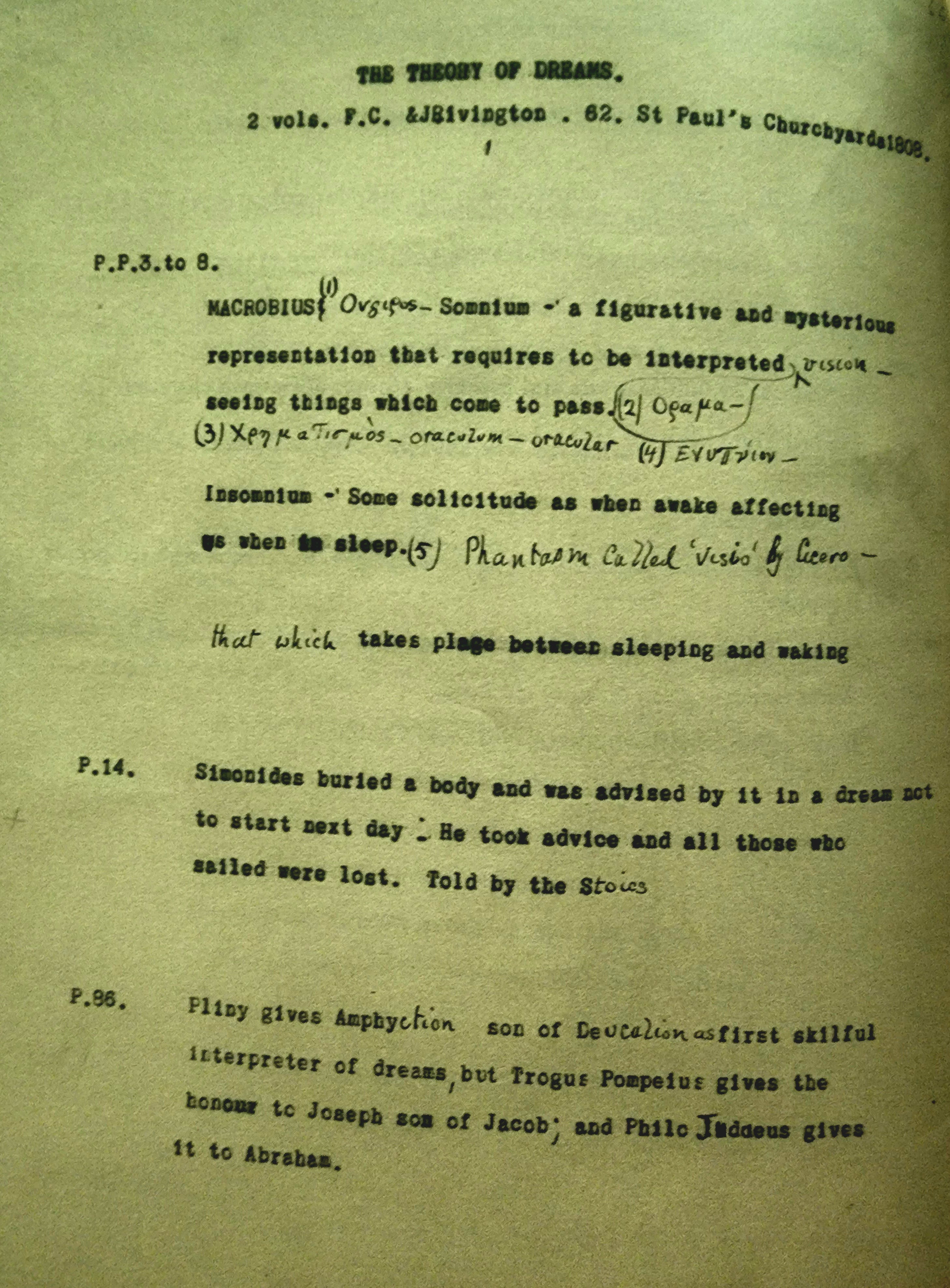
Bram Stoker had a rich tapestry of inspiration for dream states to draw from in Gothic literature long before he wrote Dracula. There are many examples. I’m excited to hear about your favorites. Here are a few that I find the most iconic:
Following the creation of the monster in Frankenstein (1818), Victor Frankenstein has a horrifying dream where he kisses Elizabeth, who then transforms into the rotting corpse of his dead mother. This is a quintessential Gothic dream. It is a nightmarish combination of desire, guilt, and realizing the “filthy” reality of his creation.
While often more emotional than truly spectral, Wuthering Heights uses dreams and visions to show that death cannot separate lovers and blurs the line between conscious reality and obsessive haunting.
We also see examples in Matthew G. Lewis’s The Monk (1796), which features intense nightmares rooted in sexual repression and supernatural interference. These are common characteristics of the “male” Gothic tradition2 and give us fascinating context to any reading of Dracula.
Thanks for being here Dear Readers, I can’t wait to chat with you here or in our Substack chat. Until next week, stay spooky.
Bram Stoker’s notes for Dracula reside at the Rosenbach in Philadelphia. They are a rare book museum and library in my hometown of Philadelphia. (Go Birds!) I’ll be reading at Blooms Day this year! So excited to join in the celebration.
The male Gothic tradition generally contains themes of disrupted gender patterns, extreme transgression, and voyeurism, where the female Gothic tradition generally contains themes of the oppression of marriage, sexual vulnerability, and the search for autonomy.
I must abandon my character and speak from 2026 for this, forgive me! Just watched the video and my jaw dropped to the floor when you mentioned that the villagers’ behavior had been orchestrated by Dracula, and also that he was himself the howling dog. I had not considered either possibility before. I rather chalked the howling dog(s) up to animals sensing evil and danger (or something in that vein). I will be paying much closer attention to those dogs and wolves!
I was also surprised about the hidden meaning of the castle that cannot be located on any map as a clue to the sort of unreality that our man of reason is about to enter.
Sorry I go on and on but I MUST mention the following dream state references!
“Last night I dreamt I went to Manderley again” - from Rebecca, carrying on the gothic tradition in the 20th century. Classic!
Wilkie Collins’ The Woman in White is awash with references to dreams, and so many gorgeous ones I couldn’t possibly choose, not to mention the very title is such an almost cliché vision either in dreams or in supernatural tales.
And finally, another written well into the 20th but set in 1900, Picnic at Hanging Rock, also carrying on the tradition but also borrowing from the idea of dreamtime in aboriginal Australian culture - GORGEOUS, I will admit to recency bias but I loved that little gem of a novel so so much.
I feel like a little spider is weaving an elaborate web in my brain, making some sense of all of these things.
Thanks - loved the video and the accompanying piece. It's really hard to try to imagine the experience of reading this for the first time when it came out. Dracula is so soaked into our culture that every scene is brimming with associations and baggage. It must have been really thrilling to pick up that alarming looking yellow book!