
Mina Murray and Florence Stoker: Gender Roles in Dracula
A Tale of Two Women

Dear Reader,
Welcome back to our Dracula read-along, and welcome to chapter nine! Here is this week’s YouTube Video for the chapter overview and analysis.
Last week we defined the Victorian concept of “the new woman” and analyzed how it applied to two women of great significance to Bram Stoker. The first was his close friend, legendary British stage actress Ellen Terry, and the other was none other than his fictional creation, miss Lucy Westenra.
Next week I’ll go back to providing reading recommendations to deepen your knowledge of the work considered foundational to Dracula, but I’d still love for you to check out Sundays with Dracula*(insert link) on YouTube. It is the deepest level of Dracula conversation I’m aware of here on Al Gore’s internet, and it is available (for free) to all enterprising Dracuphiles. This episode features Les Klinger, author/editor of the New Annotated Dracula.
The Sherlockian approach to “The Game” from this episode is the inspiration for our “Read Dracula Like a Victorian” storytellers chat. The goal there is to inspire an even deeper understanding of the story by creating a Victorian era fictionalized character or version of yourself so you can try to imagine what it might have been like for a first edition reader to experience Dracula. We’re still getting established, but I plan to eventually include some additional meta-fictional elements within the read-along. Bram Stoker gave us a sandbox to play in when he published his novel in 1897, and I think he’d be delighted we’re still using it to build “Castles in the Air” to this day.
One of the most exciting developments in the chapter is that the Crew of Light is now rounded out with the addition of Van Helsing. Leading up to this point in the book, there has been much discussion of weddings, but in chapter nine one actually occurs. Mina marries Jonathan (complete with all of the required symbols and trappings) while he is literally still recovering in a sickbed in Budapest. This is the chapter when Lucy Westenra and good ol’ buddy Art are able to set a wedding date (September 28.) Doesn’t this all just make it more interesting that Renfield has been rambling about brides and bridegrooms for a while now?
This week we’re continuing our discussion of the “new woman” by talking about our dear madame Mina, and Bram Stoker’s bombshell of a wife, Florence. I’ll introduce them in a minute because to truly understand the concept of “the new woman,” we first have to introduce her opposite. If “the new woman” represented a radical threat to the British Empire, what was the Victorian ideal of femininity?
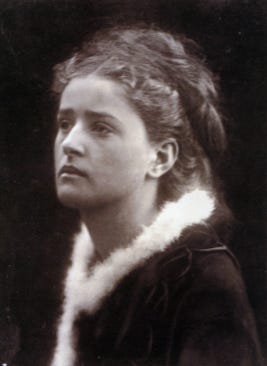
By 1897, Coventry Patmore’s narrative poem The Angel in the House had become a cultural shorthand for the ultimate Victorian feminine ideal. She was the selfless, submissive, and morally pure wife and mother who dedicated her life to domestic tranquility. The poem promoted the theory of separate spheres. It established that men were built for public work and civic obligations, while women were naturally predisposed to be caretakers of the private, domestic sphere. It’s worth noting that while the concept of “separate spheres” existed long before this time, it was this period that solidified and entrenched it in the minds of the public.
The theory posits men were responsible for the public sphere that was associated with the outside world, commerce, politics, law, and industry. Men were expected to be competitive, rational, and physically active, serving as the sole breadwinners.
By contrast, women were responsible for the private sphere, which centered entirely on the home, family, and religion. Women were expected to be nurturing, submissive, and domestic, acting as moral guides who provided a peaceful, spiritual sanctuary for men returning from the often morally corrupt world of business.
One of the core issues with this ideology was that it is rooted in gender inequality. While the ideology claimed that both spheres were equal in importance, it primarily benefited men by giving them economic power and legal control over family assets, while confining women to dependent roles.
Gender equality wasn’t the only issue at hand. The rigid application of this concept was largely an ideal for the affluent and middle classes. Working-class and impoverished women frequently had to work in factories as domestic servants or in agriculture simply to survive, meaning they could rarely afford to be exclusively domestic.
According to the “Angel” persona of the poem, the idealized woman was expected to be unselfish, gentle, pure, and devoted to serving her husband and managing the household. In return for this submission, she was promised security, protection, and moral reverence.
Now that we’ve outfitted our hunting kit with the necessary tools, let’s get back to talking about weddings. We’ll start off with Bram Stoker’s own wedding to his dazzling bride, Florence Anne Lemon Stoker (née Balcombe, July 17 1858 –May 25 1937)
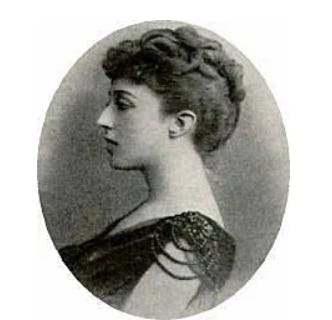
In 1876 Florence was known as one of the most beautiful socialites in Dublin. She was seriously courted by Oscar Wilde, who openly admired her aesthetic but lamented her poverty. Wilde called her “Florrie,” and Stoker biographer David Skal quotes Wilde as saying this of the courtship in his 2018 Bram Stoker Biography Something in the Blood1:
“I am just going out to bring an exquisitely pretty girl to afternoon service in the Cathedral. She is just seventeen with the most perfectly beautiful face I ever saw and not a sixpence of money. I will show you her photograph when I see you next”
It seems likely that Oscar Wilde would have happily married Florence, but he needed to secure a romantic match that came with a considerable dowry. This is probably why there were (seemingly) no hard feelings when Florence instead married Bram Stoker on December 4, 1878 at St. Anne’s Parish Church in Dublin. The newly wed Stokers moved to London the same month so Bram could take up his post with Henry Irving at the Lyceum theater.
Bram and Florence Stoker shared a devoted but complex marriage and working partnership. Most details about the nature of the Stoker’s marriage are based purely on assumptions and rumors, but the prevailing belief seems to categorize their marriage as mostly platonic after the birth of their only son, Irving Noel Thornley Stoker2 (Noel), on December 31, 1879.
It seems entirely possible to me that romantic fulfillment simply wasn’t an expectation for the couple. They collaborated closely and presented a united front to the world. I haven’t read any accounts that describe Florence as a happy woman, but she was effective. After Bram’s death in April of 19123, Florence became his fiercely protective literary executor.
Within this very real world example of Bram Stoker’s life, it’s much easier to see the doctrine of the “new woman” and the Angel in the House at work.
Back in chapter 9 of Dracula, Mina Harker exemplifies the Victorian “Angel in the House” ideal by focusing entirely on nurturing her recovering husband, Jonathan, and sacrificing her own needs for his care. She demonstrates this devotion through unwavering duty, shielding him from stress by sealing his diary, and advising a similar submissive role for Lucy to achieve a “happy” marriage. This is why she likely felt safe to Victorian readers, but they might have felt conflicted by her demonstration of intellect, efficiency, and agency, which contrast with traditional Victorian gender roles.
Many traditional readings of chapter nine focus on Jonathan’s journal being a symbol of the Harkers trust, but I think we need to dig deeper. Maybe it’s just me, but I’m not so sure starting a marriage with an agreement to conceal trauma and keep secrets works out well for anyone in the end, but that’s something we’ll unpack on another day.
Thanks for being here, Dear Reader. Thank you for caring about me and the words that trickle out of my brain. Until next week, stay Spooky.
I am an affiliate of bookshop.org. This means I earn a small comission if you purchase through my link. More importantly, this means your purchase supports indie bookstores in my adopted hometown of Philadelphia.
Henry Irving stood as Noel’s Godfather.
Bram’s death was the same week as the sinking of the Titanic
Julia Cameron also photographed Alice Liddell when Alice was in her 20s. Cameron's photographs are fascinating as early photographic art, a record of Victorian aesthetics, and just in themselves. She was born in India and wound up spending the latter part of her life in Ceylon, so she is also an exemplar of the globalised lives English people could live during the height of their empire.
https://www.metmuseum.org/art/collection/search/270819
I've spent many fascinated hours poring over her photographs, as reproduced online.
I think I gasped out loud when I read the Norton note about Florence and Oscar. Norton with the hot goss! 😅 My brain seems to want to find a parallel to Kate Reed’s insinuation that there is some romantic entanglement in Jonathan’s past that causes Mina some embarrassment. The more I learn about Bram the more I see threads of his own life woven through the novel. But I don’t know if I am seeing things that aren’t really there.
As much as Bram may have written himself into Mina, it sounds like maybe he wrote Florence in too, as Mina is surely also effective! As much as Mina perhaps strives to embody the Angel of the House (ew ew ew ew) ideal, and is pretty successful at it, she would probably be extremely bored and unhappy if she did not engage her mind in some way. Later in the novel we see that she doesn’t last very long when she is cut from the action. She’s too useful to be shelved like that!
I suspect Lucy would also be bored by being an Angel, but we don’t really get to find out for sure. To everyone who doesn’t witness her being changed before her death and undeath, she forever remains the Victorian ideal, and those who do witness it go to great lengths to ensure that is how she is remembered. Reputation intact, sweetness and light forever. (Sigh... I think I need to make “Justice for Lucy t-shirts lol)