
Read Dracula Like a Victorian: Chapter Three
There Are Bad Dreams for Those Who Sleep Unwisely

Dear Reader,
Welcome to chapter three of our Dracula Read Along! Here is your weekly video for the chapter overview and analysis.
Can I level with you about something? One of the reasons I love Dracula is because, in the book, he’s super gay. I said what I said, and I mean it with all of the wondrous rainbow love I hold in my heart. From a critical theory perspective, I find it more of a challenge to withhold a queer reading. But in this read along, we’re attempting to read Dracula like a first edition Victorian reader, so lets dig deeper. I think you’ll be surprised by what we’re unearthing today.
Gender and sexuality are two of the most widely discussed themes in Dracula. We’re digging into them now because if there is a sex scene in the book, it’s the one at the end of chapter three between Jonathan Harker and the three vampire women. In this scene, Jonathan is “taking pleasure” in disobeying the Count’s warning (there are “bad dreams for those who sleep unwisely”) by stretching out to sleep on a couch in a room other than his own. Soon after, Jonathan is accosted by three young vampire ladies with impure intentions for Jonathan’s neck. One of these women is about to sink her fangs in when Dracula arrives on the scene and flings her away.
This scene must have been seared into Bram’s mind because it is among the first mentioned when he started planning Dracula.
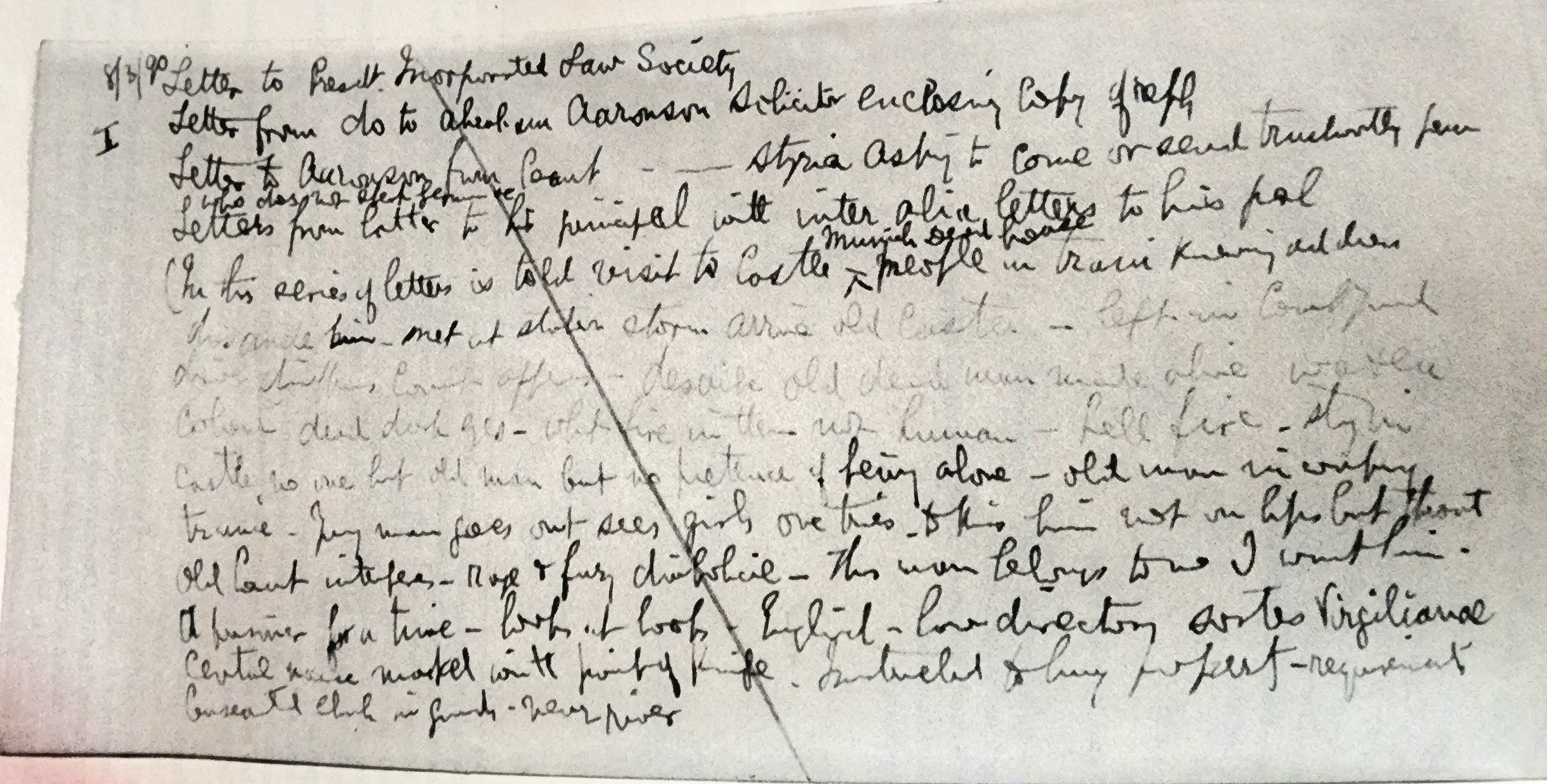
This note1 dated March 8, 1890 reads:
“Young man goes out- sees girls- one tries to kiss him not on lips but on throat- Old Count interferes- rage & fury diabolical- this man belongs to me I want him.”
Bram thought of this as a key scene in his book, and he references it several times throughout his notes. Bram made this four act outline early in his process. Here he refers to the scene by noting “the Kiss-this man belongs to me.”
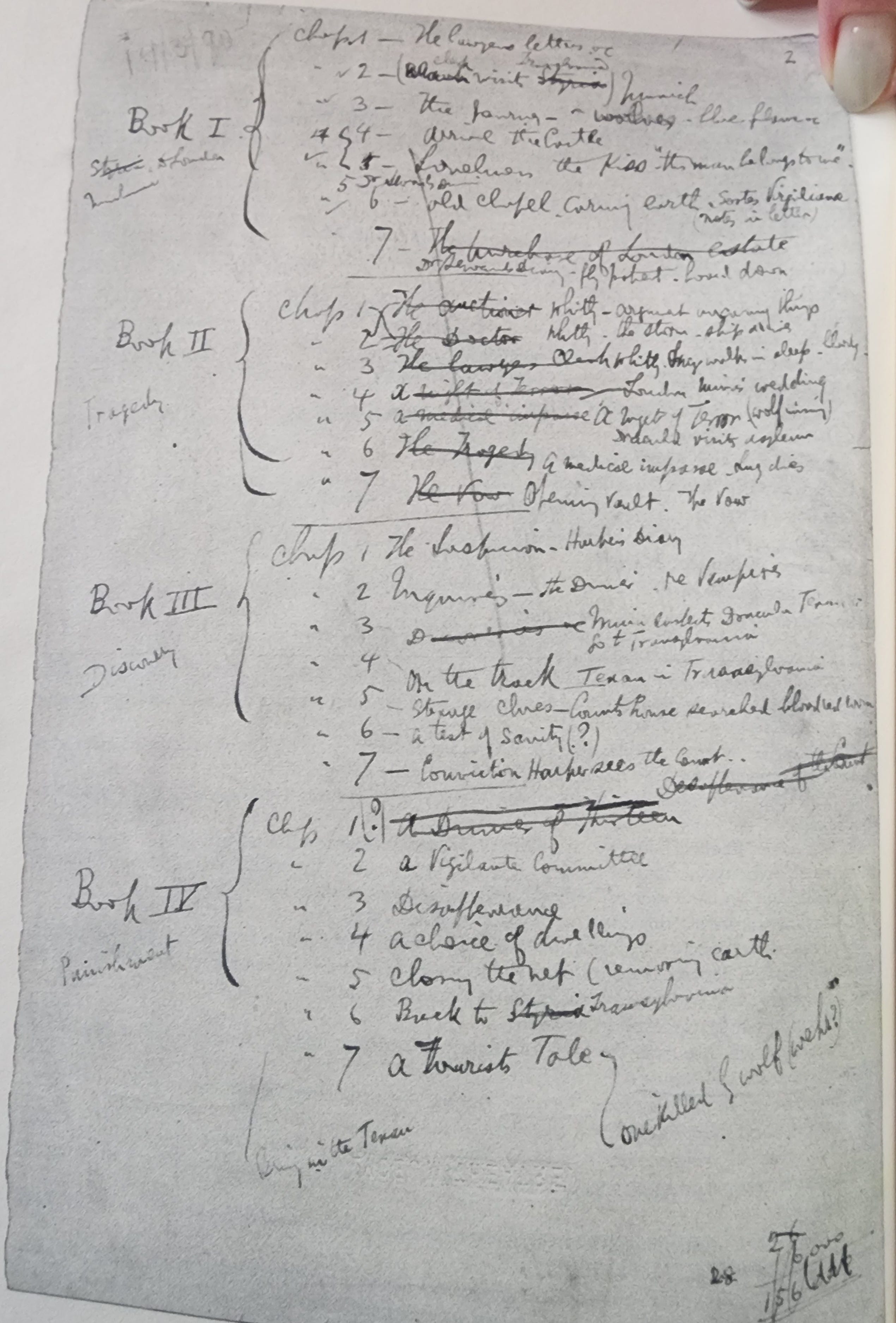
In the book when the scene concludes, the vampire women mock Dracula, saying he has never loved. Dracula responds by looking attentively at Jonathan’s face and countering, “Yes, I too can love; you yourselves can tell it from the past. Is it not so?” Finally Jonathan says he is overcome by the horror and he “sinks down unconscious.”
To me this begs the question: what horror is it that Jonathan finds so repulsive? He admits that he finds the prospect of the three vampire women kissing him both thrilling and repulsive, but earlier he clarified that he is more afraid of these “voluptuous” women than he is of the Count. We also have to remember that at this point Jonathan knows he is a prisoner, but he doesn’t realize the Count and these women view him as a literal meal. Earlier in the chapter, Jonathan speaks of his admiration and even attraction to the Count’s intellect. Doesn’t this infer that Jonathan finds the prospect of a similar encounter with the Count to be less horrific than the encounter with the three women? And doesn’t all of this feel just a little at odds with our general impression of the Victorian views on homosexuality?
Jonathan’s introduction to Count Dracula shakes him to his core and later will require weeks of recovery from his resulting “brain fever.” If you’re clutching your pearls or feeling faint, you might want to sit down for the next section. A first edition reader wouldn’t know this yet, but soon the Count will be in England wreaking havoc on virtually every known Victorian sensibility.
There may not be a better lens to consider what Victorians really thought about homosexuality than the trial and imprisonment of Oscar Wilde.
Prior to Oscar Wilde’s arrested on April 5, 1895, London enjoyed a robust, underground gay scene. In my research, I have read that Wilde’s true crime wasn’t “gross indecency,” but indiscretion. In the New Annotated Dracula, Leslie Klinger writes that “the official Victorian attitude towards homosexuality was hostile. Although anti-buggery laws were of long standing, they had fallen into disuse by the late nineteenth century.”
Don’t get me wrong, Victorian society was ruled by an incredibly strict code, but we limit our understanding if we attempt to measure that code by our modern standards. Words such as “gay” and “bisexual” didn’t come to their current meanings until far more recently. In fact, the word “homosexual” didn’t come into popular use until the 1940s. The first bible to use the word added it in 1946. Prior to 1946, translations like the King James Version (KJV) rendered these Greek terms using phrases such as “abusers of themselves with mankind” or “defile themselves with mankind.”
Early sexologists like Karl Heinrich Ulrichs, Havelock Ellis, and Sigmund Freud pioneered “inversion theory,” which suggested that homosexuality was a more literal inversion of gender. It posited that a gay man was a “woman’s soul trapped in a man’s body” (and vice versa). Victorians generally considered gender inversion to be inborn, but the theory allowed no room for the modern understanding that gender and sexuality are separate.
In 1889 the Cleveland Street scandal brought greater public awareness to the existence of a prospering queer subculture in London. This subculture existed through a network of private clubs, bathhouses, and pubs. Telegraph boys were young telegraph messengers working for the General Post Office who frequently doubled as sex workers. They were highly sought after by wealthy patrons and could often be found in specific parks and near theaters.
While the Victorians viewed gender, particularly for children, to be more fluid, by adulthood men and women were rigidly separated and expected to operate within completely different spheres of influence. All of this makes it tempting to say that Victorians were simply sexually repressed, but this outward oppression is actually the reason I think the truth is far more surprising.
Victorians found it completely normal to engage in what we now call “romantic friendships.” These were intensely passionate same sex relationships where behavior such as hand holding, cuddling, kissing, and sharing beds were all generally considered to be innocent behavior. This started to change towards the end of the century.
Oscar Wilde had been in a relationship with the son of the Marquess of Queensbury since 1891, but when he denounced him as a homosexual, Wilde sued him for libel. The case turned into an absolute media frenzy as salacious details of Wilde’s life became public, eventually leading him to drop the case. Unfortunately Pandora’s box had already been blown wide open, and Wilde was arrested in the Cadogen Hotel in Knightsbridge, London. Following a trial that the judge called “the worst case I have ever tried,” Wilde was given the maximum sentence of two years hard labor, which he served from May 25, 1895 to May 18, 1897. The judge thought even the maximum sentence was “totally inadequate for a case such as this.” Dracula was released fewer than 10 days after Wilde’s release from prison.
Today many casual observers use this as proof of romantic connections between Bram Stoker and Oscar Wilde, but (as with most things in history) the truth is more complicated. Bram was meticulous in maintaining his (and by extension Henry Irving’s) reputation. Following Wilde’s fall from grace, Bram took an even more conservative stance on withholding any potentially scandalous personal feelings he held entirely out of the eyes of the public. Considering Oscar Wilde would be dead within three years of his release from prison, I can’t say I blame him.
Thank you for being here, Dear Reader. Thank you for caring about me and the words that trickle out of my brain. Until next week, stay spooky.
Bram Stoker’s notes for writing Dracula reside at The Rosenbach in my hometown of Philadelphia. I consider myself to incredibly lucky to have the opportunity to study these precious documents in person.
🧛♂️ +🌈 = Dracula
This was a really great read, Monica...super interesting as usual! At the very least, I surmise that when Dracula was in bat form he was fly-sexual.