
Writing Lessons From Bram Stoker's Notes
Piecing Together Stoker's Writing Process

Dear Reader,
A few weeks ago, I wrote an article about how Bram Stoker wrote Dracula . In today’s essay we’re going deeper into that topic, but we’re going to hone in on some of the craft specifics Stoker uses in his work.
In the writing world, we have terminology for the different ways folks approach writing a novel. Some writers are “pansters,” meaning they write their stories “by the seat of their pants.” They don’t spend time outlining their plot in advance.
On the flipside, we have plotters. Just as you might expect from the name, these folks plot and outline their story prior to starting their first draft.
Bram Stoker was a plotter, and I think that’s something to celebrate because he left us with an amazing record of his creation process. We can’t time-travel or raise Bram from the dead to ask him about his writing, but reading his personal notes feels like glimpsing into his mind. When I got to handle them for the first time, I couldn’t help but feel they just might have been imbued with the same strange mysticism that has captivated the imagination of millions. Touching such an important part of literary history filled me with awe and wonder. It was an experience I’ll never forget.
These are my reflections on Bram Stoker’s process when I review his notes through the lens of an aspiring novelist.
Some of the earliest notes Bram made show dates in March 1890. These pages contain:
A list of characters
Several pages of notes on the powers of vampires
A list of potential letters to include
high-level plot points, including some of the key scenes of the novel
From these early notes, we can conclude that this is how Bram started his work on Dracula. He recorded early plot ideas, brainstormed his characters, developed the abilities and backstory for his antagonist, and decided on a form for the narrative.
This all sounded shockingly familiar to me because what Stoker presents in his notes is almost identical to methods I was taught by private writing coaches in recent years. But wait, there’s more because next Bram writes a one page outline (pictured below) of what would become Dracula.
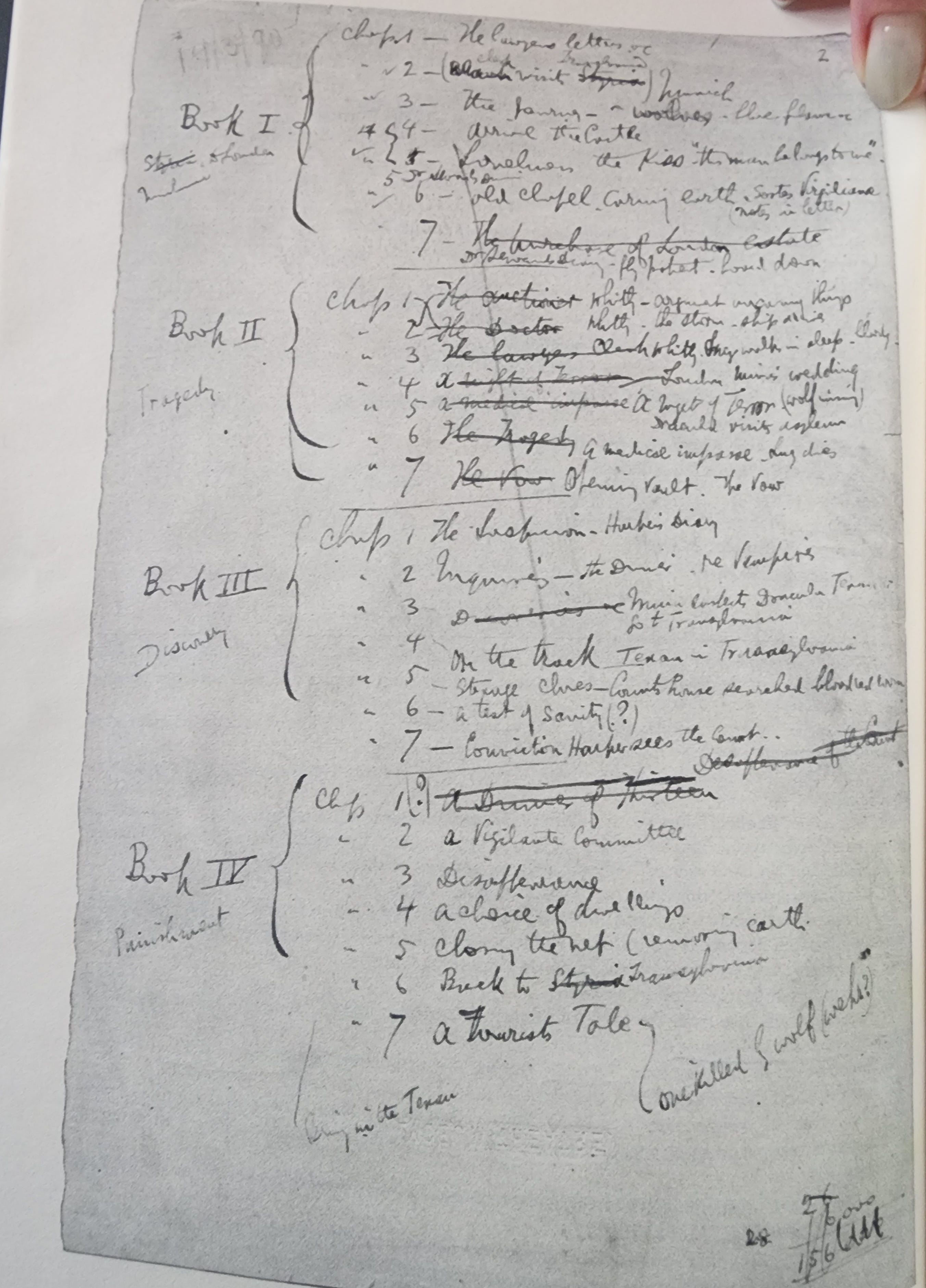
This Outline is dated March 14th, 1890
Here we can see that Stoker breaks his novel into four parts. Each part contains seven chapters and each chapter has its plot summarized in a single line. The parts also have a thematic title based on the expected action taking place in that section. Part one is just called Transylvania1 to London, part two is called “tragedy”, part three- “Discovery” and part four “Punishment.”
On the bottom right corner of the above picture, you will find a scribbled calculation. When inspected closely, we can see that Bram is using the number of planned chapters to get an approximate word count of the final manuscript. After this one page outline, Stoker worked through each section and chapter in greater detail.
At some point (likely the summer of 1894), Stoker started drafting in earnest. In 1980, a copy of an original typescript of Dracula containing Bram Stoker’s handwritten edits was found in a barn in western Pennsylvania. This was likely one of the final typescripts before printing. We have no idea how many others have been lost to time, but it is impossible that it was the only one.
One of the things I love about the notes is that they were working documents for Stoker. He didn’t trash his existing notes and start over. He went back continually to cross out a character he combined into another, or strike through a scene, or location. There is no concrete evidence of this, but my opinion is that Stoker used his notes as a reference to keep track of changes between drafts. This is another tool I learned from writing coaches. It helps remind my scattered ADHD brain of where we are in the process.
I often hear the phrase “writing is rewriting,” and it is so true. It was true for Bram Stoker, it is true for me, and (I’m guessing) it’s true for you, too. So if you find yourself struggling, or think “real” writers don’t have problems like this, yes, they do. The struggle is part of the creation, and that means it can be beautiful too.
Thank you for being here, Dear Reader. Thank you for caring about me and the words that trickle out of my brain.
Bram Stoker originally wrote “Styria” as the planned location for Count Dracula’s home. Later, Stoker crosses out “Styria” and writes in “Transylvania.
Stoker's writing process is so fascinating! As a dedicated plotter (the thought of pantsing gives me a headache), I find his early notes quite relatable.
As I go through my own planning process (for the first time), knowing Stoker's method is really helpful.